
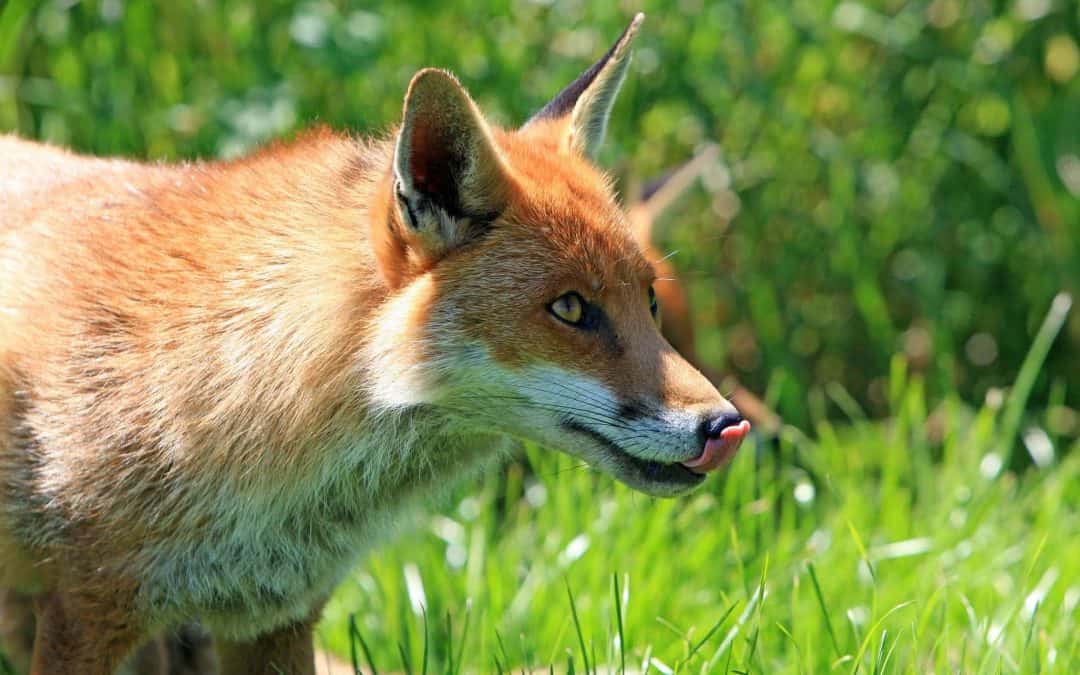
In August 2006 friends of ours who live in the New Forest brought us a young male blind fox. They had looked after it for some months but had no permanent long-term home for the cub. He was a beautiful looking fox, probably three quarters of his eventual size. His fur was the “pure fox red” which shows up so well against snow and is therefore often used by artists in snow scenes and by Christmas card manufacturers. His ears were tipped with black and so was his tail; both looked as though he had actually dipped them in black paint and then the extreme tip of his tail was white, the same snow white of his chest and belly.
He was a very fine looking fox. It was unfortunate that he seemed to have been born blind or became blind very soon after birth. Apparently, he had been taken to our friend by a kindly sort who found Felix, as he was named, on the side of a road in a bad way when he was very young. Our friend had looked after him for some months and had become very fond of him. Often one becomes more emotionally involved with an animal that has an obvious disability. We once looked after a Starling with one and a half wings. This bird was a real character and Gertie, as she was named, grew on everyone she met.
Felix was considered a difficult case in that nobody was quite sure whether he should be kept on his own or with other foxes. And then whether he should be housed with others older than himself, whether he would be traumatised or even worse, bullied and then traumatised.
We considered the situation carefully. At the time Cherry had three permanently housed foxes. Sybil was the oldest at nearly 6 years. She was the tamest, warm and kind, and had never bitten or attempted to bite. She would roll over to have her tummy tickled and loved being scratched behind the ears. Originally she had been looked after by a local man but as she started to grow and smell “foxy” her keeper, who coincidentally was working away from home and back at weekends. His wife, not really liking animals and especially did not like her garage converted into a very smelly fox den, needed her rehomed. Inevitably, at about three months, a very well grown fox, which had very little regular interaction with human beings and none with other foxes since she was a cub was looking for a good home.
She was brought to us in a large wire cage. Without thought or fear, Cherry put her fingers in through the wire and tickled the fox’s neck, possibly a bit reckless! But, from that minute on Cherry formed a wonderfully close relationship with this fox. We called her Sybil. She was the fox who received visits from an amorous adult fox the previous winter. The dog fox actually made a hole in the wire of Sybil’s enclosure and we left it open far in excess of a month. We had hoped at the time that Sybil may have mated and had cubs, but this did not happen. Nor did she show any wish to leave her enclosure. So we considered young Felix might well be able to live with Sybil, who was by her own volition, a permanent resident. Nevertheless, it is always a breathless and worrying time when finally, two animals are introduced however much thinking and planning has pre-ceded the decision.
Our friend, who is a very experienced ‘animal person’, Cherry and I, all very quietly gathered around the enclosure and Sybil, as always, welcomed everybody by running up and down wagging her tail and “laughing” at us with a deep grin. The box in which Felix had travelled was taken into the enclosure and the door was opened. We all retired outside and watched. Sybil immediately stretched her nose towards the box, sniffing and snuffling and Felix’s nose touched hers. He retreated but quickly came forward again. The food dish was left full of chicks, canned dog food and some dry biscuit. We left them as Felix came out of his box and immediately shot down one of the holes to Sybil’s Earth. There was nothing further that we could do, so we went in for supper. For the next week Sybil and Felix settled together. The most amazing behaviour we witnessed was Sybil taking food from the bowl as soon as they were fed each day, and calling Felix with calm squeaking calls at the earth entrances. After a few minutes initially, and eventually almost immediately, Felix would come out from one of the holes and Sybil would, continuing her squeaking calls, pass the food to Felix. He would then eat it or take it back underground to eat. Sybil, as she had been with us and other humans, was always gentle with him. After three months, Felix had totally settled, knew his enclosure and the underground earth dug by Sybil. Both he and Sybil would always greet Cherry with wagging tails, whining or gentle barking. It was difficult to know whether Felix’s blindness was inherited and would be passed on to any offspring. As it happened Felix and Sybil never produced cubs – sometimes nature has a way of taking the right course.

- A collection of short stories -
Tony is a passionate writer as well as an active conservationist. He is currently working on a number of books and we are delighted to be able to share a few stories from them.