
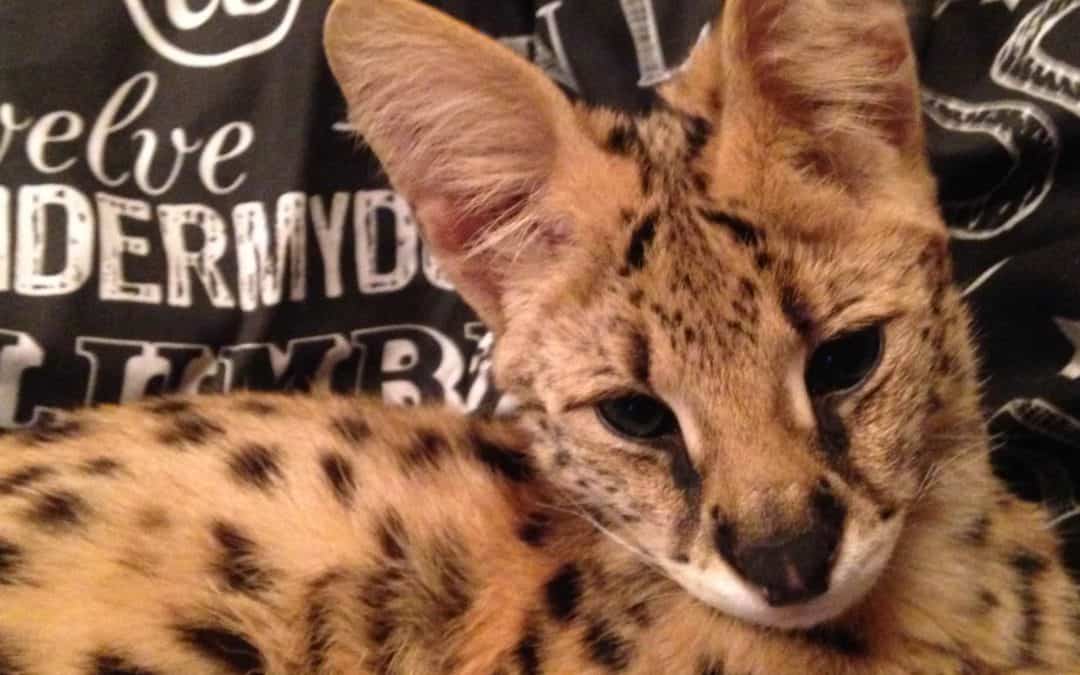
On mid-summers day, a stunning warm day early bright sun was welcome to all in country and town. Unfortunately, due to Cherry’s illnesses earlier in the year, Cherry had been unable to put up her usual 17 hanging baskets. We were lucky to find a very reasonable plant wholesaler who also simply loved putting hanging baskets together and we ordered some to arrive that day. Inevitably, these very lovely people also wanted to see the animal collection. When walking past the older Serval pair, India and Quito, I noticed a tiny bundle of fur and blood. I said nothing at the time. As soon as our visitors departed I went back to check.
It did not make sense that India would give birth in the open, I thought, as I walked across. She had plenty of nest boxes and had always used her favourite. Equally surprising was the fact that no one had recognised India was pregnant. We tend to separate the male in this species. There were absolutely no signs. As I walked towards the enclosure, all these thoughts were weaving around my mind. We will never really know the facts. However, the tiny bundle of “bloody fur” was clearly not newly born. In fact, our best estimate was that it was possibly about a fortnight old. Its eyes were open but cloudy. It was in a terrible state. Mother had obviously brought it out for us to sort out. This has happened many times over the years when the mother is no longer able to for whatever reason. There is a certain trust between animal and keeper that in times of stress works to the good. I went into the enclosure. The male was in a far area well away. Quito is generally kind but he is powerful and quite capable of being rough on occasions. India sat watching Rab and me as we picked up the kitten. We were both shocked. Its head rolled on a very weak neck and it seemed as near death as possible. We took it straight into the house. Quickly in a bowl of very warm water as the kitten was cold, we cleaned the blood away and it was evident that the source of the blood was a nasty slash across its throat. It looked as though it had been carried out surgically with a scalpel. Worst of all was that the wound was crawling with tiny white, flesh-eating maggots. As we looked more carefully was saw small bunches of blowfly eggs. At that point, everything was against this little mite. It was near death, being eaten alive and very cold. Slowly the maggots were picked out with tiny tweezers. The creature was washed in a “hipi scrub,” a soft pink fluid used as an anti-bacterial wash in hospitals. The fly eggs were removed. Once warmed with the heat of the water, we then dried the little girl (we now knew that she was female) with a domestic hair dryer set on moderate. We had done our best; cleaned out the wound and wrapped her tightly in tin foil and we did our best to feed her with a bottle. Rab volunteered to take care of “Stella,” named after a lovely lady he had met earlier in Kenya. He took over the feeding and took her home in a small animal incubator which was set at the temperature to try to overcome little Stella’s shock.
The following morning Rab brought the incubator back. Both Cherry and I assumed Stella had died in the night. The odds really were 100 to 1 against. Miraculously Rab had managed to get enough milk into her “tummy” to keep her alive and she had slept all night in the crook of his arm. However, he did look worried. We had another close look at the wound. It looked clean but there were three newly hatched maggots. These were removed. It was amazing that we had managed the clear all the eggs and maggots other than these three. We washed the gash carefully and found no more signs of maggots or eggs. Fortunately, that was the last of the infestation. The odds were heavily against little Stella living but she did survive and she now lives with Rab and sleeps on his feet. She does not seem to notice animals on the television; whenever there are birds in the screen she stops whatever she is doing and goes straight to the TV, watching with enormous interest. Her recovery was entirely due to Rabs diligence, keeping her fed every two hours initially and keeping her warm with his own body heat. He has become totally involved with her. Earlier in the year, he lost his dog, Blue, named after her one blue eye. She was some 14 years old and had become his permanent companion. Stella had definitely eased the loss, if for no other reason than she was such a huge commitment day and night.
We spent hours considering what had happened. We ultimately concluded, without proof, that the female Serval, India, was probably moving the kitten from one nest box to another. The male, Quito, almost casually, simply clawed the kitten thinking the female had found some food. With the intention of taking ‘the food’ Quito had extended his claws and thus slashed the kittens throat. At that time of year flies lay eggs within minutes. I am convinced that India brought the kitten out so that we, her keepers, should find the kitten and help her save the poor mite’s life. Fortunately, we and particularly Rab, did just that. Had India showed any increased weight or other sign of pregnancy, we would have removed the male before birth to avoid just such a consequence.