
May and June and more than half of July has gone in a flash. Cherry and I have had a lot on and so much has happened at the Conservancy.
On the 2nd May we went to stay in the New Forest for a few days. On that day we heard our first Cuckoo and saw only our 3rd Swallow of the year.
We went to see Jason Palmer, Curator of The New Forest Wildlife Park, an absolutely beautiful naturally set park, specialising in Otters of the world including the Amazing Giant Otter and owls. Particularly interesting is the small herd of European Bison, the European equivalent of the ‘American Buffalo’ also needing good conservation. This year Jason has bred Pine Martens and has promised us a female (recently born in the park) later in the year to go with our male.
We visited the New Forest Reptile Centre, run jointly by English Heritage (with our friend Martin Noble who is dedicated to European and especially British reptiles and amphibians) and the RSPB.
We managed to see all but one of the British reptiles, the grass snake being the exception. It is very difficult to feed in captivity. But we delighted in watching Adders, especially a nearly “solid black” coloured female and some very small yearlings, smooth snakes and Sand Lizards, particularly suited to heaths of the New Forest and Dorset, and seen nowhere else in the south, then the more common Slow Worms and Common Lizard. We also were amused watching the rare Natterjack Toads running around, like mice, feeding on mealworms fed by a volunteer.
Most intriguing is the RSPB camera permanently sighted on a Goshawk nest. The female, startling yellow eyes and soft greyish brown plumage appeared to be sitting on 4 eggs.
On the 5th May, 5 baby Coati Mundis were born. The mother was very proud and protective of her young. We separated the male to protect him from her over-zealous behaviour. By the time of writing, all are well grown and will be going to a collection in Sussex.
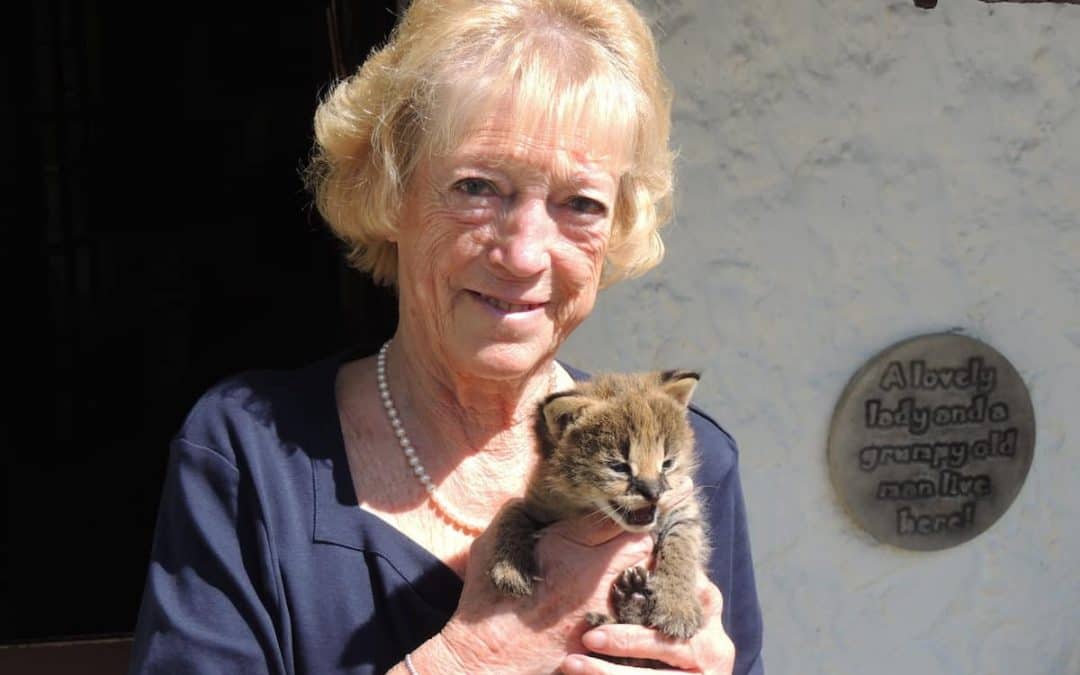
On both the 17th and 19th of May two pairs of kittens were born to our female Lynx. Again, all are doing well. The females keep the huge male at bay, although he is very good with the kittens. At the time of writing we have agreed to give one female and her two kittens to my friends Andy and Jayne at Axe Valley Wildlife Park, a small zoo started 10 years ago where the animals are really well treated in beautiful enclosures.
On the 20th May, Rab completed a really quite special house with heating and lights, indoor nest box and living area as well as a well branched outside enclosure for our acquired (loaned to us) Rusty Spotted Cat, reputed to be the smallest wild cat in the world. We hope to receive a male later and have already built and introductory enclosure next to the main house to let the cats get used to each other.
On 25th May we were given 2 Greek Spur Thighed Tortoises (introduced by Lynda of Liberty’s, a really nice reptile and raptor centre in the New Forest).
On the 2nd June, a pair of kittens were born to our Fishing Cats. Since we had a difficult history in the past, we decided to keep mum and babies in their den for a month. We did this and we can continue the story next month.
During the months of May and June it was clear how many birds had bred in the Conservancy. I list them below, indicating if they had used the boxes put up by us (B).
- Blackbird
- Song Thrush
- Robin
- Wren (B)
- Hedge Sparrow
- Moorhen
- Wild Duck
- Blue Tit (B)
- Great Tit (B)
- Coal Tit (B)
- Greater Spotted Woodpecker
- Long Tailed Tit
- Chaffinch
- Goldfinch
- Siskin
- House Sparrow (B)
- Jackdaw (B)
- Rook
- Common Crow
- Magpie
- Jay
- Nuthatch
- Tree Creeper
- Goldcrest
- Wood Pigeon
- Pheasant
- Tawny Owl
- Bullfinch
This is the list of definites. Young Kingfishers, Herons and Buzzards have visited and clearly have bred very close to us.
We travelled to the Isles of Scilly for the longest day – 21st June. It is such a beautiful place for enjoying the islands, the sea and bird life on the long summer days and evenings. We enjoyed the sunniest week of the year so far but because of sea breezes, it was always moderate warmth.
We saw Gannet, Manx Shearwaters and Kittiwakes on the way to the isles. There, we saw the auk family represented by Razorbills, Guillemots and the ‘sea parrots’ – the Puffins! We saw them all carrying fish to their young. Shags, brilliant bottle green with crests are far more common than Cormorants and we saw rafts of Manx Shearwaters, relatives of the Albertross floating out to sea.
In June we had already seen all the butterflies seen in the Scillies, namely:
- Red Admiral
- Common Blue
- Small Tortoiseshell
- Meadow Brown
- Small Brown
- Small White
Sadly, we saw no Peacocks or Painted Ladies although we saw them in May at the Conservancy with Comma, Orange Tip and Brimstone.
I have written an extra story about Frankie the Fox saved by our vets and now being in a permanent home with us.
Ironically enough the day he was brought to us, we watched a young fox about the same age playing in the field opposite our bedroom. At the same time a young Kingfisher visited, it was a good May and June.