
March started with a bang!
Early in the month we said goodbye to our now well grown male Fishing Cat as he went off to his new home in the Axe Valley. Along with him went two young Azara Agouti and seven Harvest Mice. Our friend Andy, who owns the Wildlife Park brought us a male Palma Wallaby. He will join our small breeding group.

Palma Wallabies were first discovered in 1840. They are a small shy wallaby. It was believed extinct in its home of New South Wales, Australia by the late 1880’s. In 1965 some 85 years later a further colony was found in Kawau Island near Auckland, New Zealand. In 1967 a surprise sighting led to the discovery of a further original population living in the forests from Gosford, New South Wales all the way along the Great Dividing Range to Queensland. It is still rare and classified as threatened.
Andy also brought us a pair of Meerkats, an animal about which every visitor asks “have you got Meerkats?” This particular pair are two brothers but as soon as Andy’s alternative Meerkat family unit breed females, he will let us have them.
During the early part of the second week of March, it was discovered that we had two more babies, this time, Fishing Cat kittens. Mother and babies are doing well, although we have had to alter this figure to three kittens – one more was sighted by the keepers early on a Thursday morning. We are thrilled. Unfortunately, for reasons beyond us, they all died. Conservation is always two steps forward, one step and occasionally two steps back. But we must keep going.
*************************
Since we have now started writing these Newsletters more regularly, we thought it might be interesting for members and others to know exactly what we have in our Conservancy. We have listed them under the differing general groups (if they have bred over their time with us they are marked ‘B’
Cats
B. Puma’s (Mountain Lions)
B. Eurasion Lynx
B. Asian Leopard Cats
B. African Servals
B. Scottish Wildcats (British)
B. Jaguarundi (South America)
B. Malaysian Fishing Cat
Ocelot (South America)
Lemurs (Madagasca)
Ring Tailed Lemurs
Black & White Ruffed Lemurs
Other Carnivores
B. Malaysian Short Clawed Otters
B. European Otters
B. Coati Mundi (South America)
B. Yellow Mongoose (South Africa)
B. Racoon Dog (Japan)
Pine Marten (British)*
B. Meerkats (Kalahari, South Africa)
Rodents
B. Capybara (South America)
Mara (South America)
B. European Harvest Mouse (British)
B. Azara’s Agouti
Other Animals
B. Bennett’s Wallaby
B. Palma Wallaby
B. Madagascan Hedgehog Tenrec
Other British Animals
B. Barn Owl
B. European Hedgehog (Rescue)
Reptiles and Amphibians
Russian Horsfield Tortoise
African Spur Thighed Tortoise
Greek Spur Thighed Tortoise
B. Hermans Tortoise (Mediterranean)
European Green Tree Frog
British Common Frog
Red Necked Terrapin (Rescue)
Yellow Throat Terrapin (Rescue)
Domestic Species
B. New Zealand Kuni Kuni Pig
B. Senegalese Pygmy Goat
B. Scottish Soay Sheep
Miniature Shetland
Bodmin Hill Pony
Birds
European Stork
B. Harris Hawk
B. Indian Pea Fowl
Asian Red Billed Magpie
B. Helmeted Guinea Fowl
B. Java Sparrow
B. Mouse Bird
Orange Headed Weaver
B. Bali Mynah
Usually about 50 species – upwards of 200 animals.
*************************
Although fairly wet we had some long dry days and the clock went forward towards the end of the month giving us longer evenings. The birds in the Nature Reserve were hard at work courting, singing and gathering material for nesting. By the end of the month we already had Jackdaws, Magpies, House Sparrows, Blue Tits and Great Tits with completed nests, some in our boxes which were put up in February. Dunnocks (what we used to call Hedge Sparrows), Chaffinches, beautiful Goldfinches and Great Tits were all nest building.
One really good piece of news is the Rooks nesting in the large oak tree. When we arrived 33 years ago, there were many nests every year, but about 10 years ago there was a very nasty storm and all the nests were blown down. The Rooks returned in January and February to survey their old breeding haunts. In spite of much “cawing conversation” they did not stay to rebuild. We saw no sign of them until 2016, when 3 large untidy nests were built and young were fledged.
At the beginning of March (later than in previous years) many Rooks returned and long cawing and croaking sessions took place.
Very quickly it was apparent that the 3 old nests were being renovated. After 2 weeks, a further nest was built and now we have 5. We both love the “cawing messages” of the male birds keeping company with their mates incubating their eggs. We have high hopes of a good breeding outcome and for not too many storms.
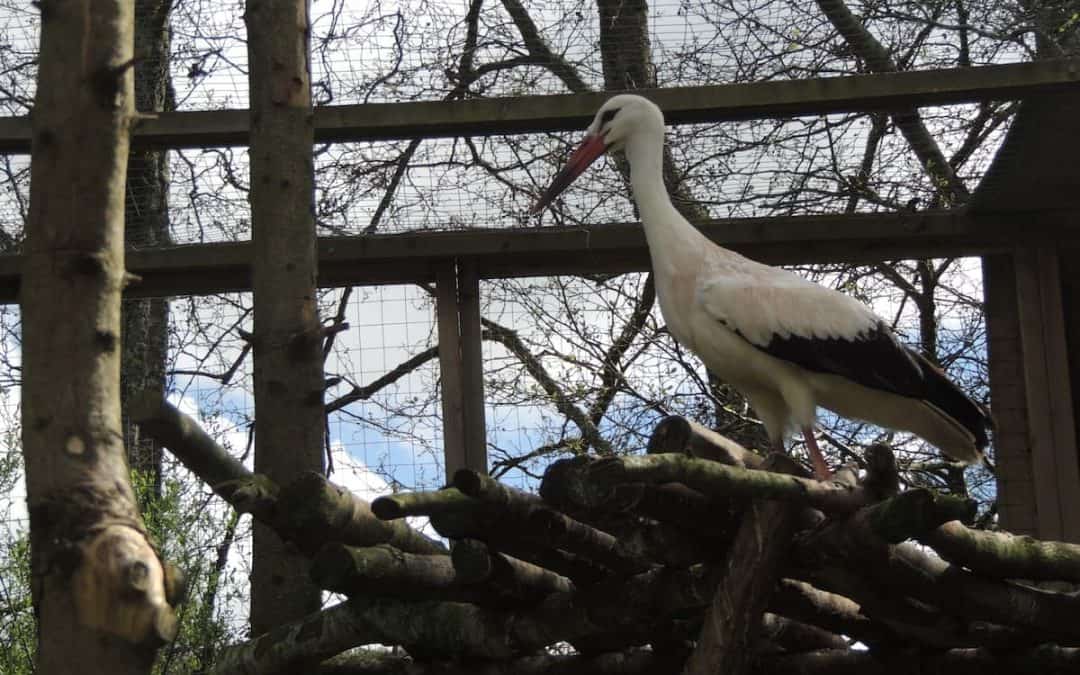
Earlier in the month after a series of high winds and heavy gusts, a wooden panel was blown out of the side of the Stork enclosure. Inevitably one of our four was blown out and for several days was at complete liberty, but never far away from the aviary except for the first day when it appeared to have been caught on the wind and blown into the field next door to our reserve.
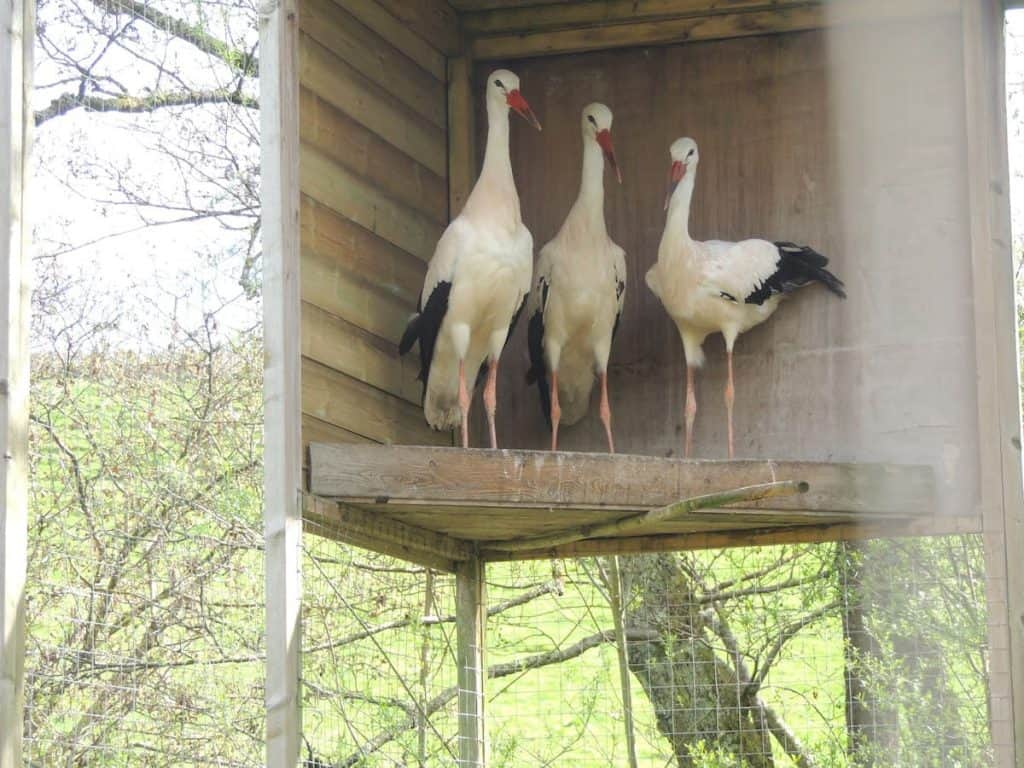
By nightfall the Stork had returned and roosted above its pals on the top of the aviary. Catching a Stork is like catching a hat in the wind. Every time you get within a few feet, it flies off just out of reach. So, we set about temporarily dividing the “entry area” of the aviary to about a third and leaving the door open with some nice tempting sprats as a bait in order to trap the bird back into the aviary. The door was attached to an extensive length of twine about 50 feet long and on the third day of his freedom the Stork was happily eating his sprats, the twine was pulled from a hidden position, the door shut and he was back with his friends.
It was strange that the other three ignored him for several days as though they were rather disappointed in his behaviour, but all is well again and the temporary division in the aviary is down. (Photo of the errant Stork and his 3 confiding friends attached).
We have 4 European Tree Frogs, grown from tadpoles and hatched last year by a friend in the New Forrest. On the 8th March they started to croak for the first time. They live in our kitchen and at this time of year they sound like ducks, very loud for their size.
On the 12th March I heard the first Chiffchaff, the charming little migrant warbler that calls its own name incessantly all day. A real sign of spring.
We’ve seen the first butterflies, small tortoiseshells, Whites and Brimstones, a delightful mellow yellow. The primrose and violet show in our lane is fantastic.
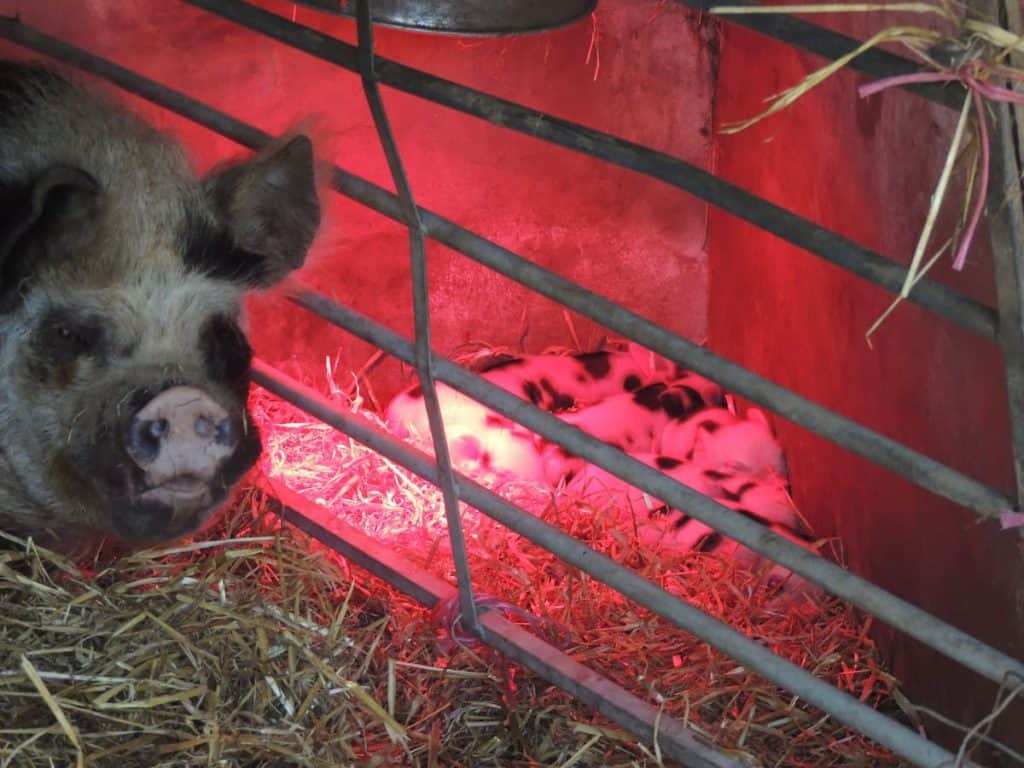
To end the month, our Kuni Kuni sow produced 6 piglets, tiny black and white creatures, not as large as a guinea pig.