
Animal Collection and Nature Reserve
July 2020 Newsletter
Lockdown has not been the struggle for us as it has been for so many. We can walk our dogs in our fields and exercise ourselves by mountains of gardening, landscaping, hedge trimming and the like. The list goes on for ever.
The month has started well. On the first day of the month we enjoyed 10 goldfinches feeding on the seeds hung outside our bedroom window.
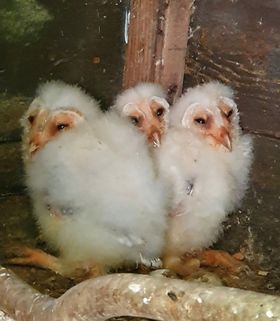
Early in the month I found a hummingbird hawk moth hiding in the undergrowth when walking the dogs. And that same day we had some barn owl chicks hatch – you may remember the female barn owl which had a very nasty injury on its leg. It is a reflection of our keeper Pixie who has taken care of the bird.
Going back to the humming bird hawk moth. These are a stunning member of the moth family but they fly during the daylight around trees such as buddleia and other sweet scented flowering bushes including honeysuckle. On the whole, they are uncommon, migrating to us in July and August from the South of France.
On Sunday the 5th again walking the dogs, a huge green headed dragonfly settled on a bush directly in front of me. It was a female emperor, our largest. Its long tail was barred with black and white, but I did not have my camera with me. The closest I have ever been, still as the grave, and no camera.
We are aware how lucky we are to live on our Nature Reserve, but today we awoke to the chirping of numerous baby house sparrows and then a couple of young long tailed tits joined them on the fatballs. We have had no long tailed tits visiting for May and June. The parents feed the young live food; insects and other invertebrate and do not subsidise with nuts, fats and seeds as so many have learnt to do. We were thrilled to see them back.
A rather longer wait for house sparrows. When we moved to Tredivett Mill in 1983, there were no sightings of house sparrows. Believe it or not, there were no signs of house sparrows for seventeen years. When we did eventually see a pair, within twenty-four hours we put up two sparrow terrace nest boxes. They moved in and now twenty years on we have dozens of the jovial little fellows, chattering, chirping, having the odd spat, some flying off in a huff, and above all bringing lots of little sparrowlets into the world.
When finally we have got up (having risen earlier to feed the dogs, and taken our tea and breakfast back up to bed), as I open the top half of the stable door at the front of the house, I am welcomed by five peacocks who fly down for a quick snack of whatever is going, stale bread, a piece of pizza, stale cake or similar.
Then, some quite good news this late in the breeding season; a pair of stock doves are nesting in one of our next boxes in the lane. These are more subtle than the more familiar wood pigeon, more subtle in colour and with no white ring around the neck. Their crooning takes on a gentler deeper note. Above all, it is another nesting species to the Reserve.
On the 10th July, Cherry and I went for a pub lunch at Rock Inn at Haytor, where we were booked in for a couple of days later in the month. It was our first outing for four months and we thoroughly enjoyed lunch and saw a number of birds; buzzards, kestrels, ravens, linnets, meadow pipits, lots of low flying swallows and a large cock mistle thrush, not very common in the west.
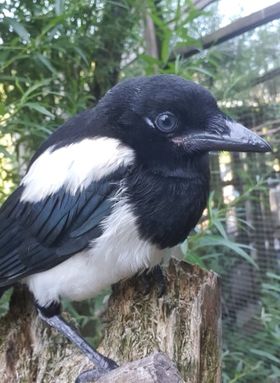
A large flock of magpies awoke us the next day feeding at the bird hangers and then visited our rescue making a lot of fuss over him.
Meadow browns, small white, gatekeeper and speckled brown butterfly abound in the lane on the 12th July.
13th July, we now have three baby barn owls, all growing fast. A visit from a garden warbler to our bird table alongside long tailed tits again was a surprise. All the usual – chaffinch, goldfinch, blue tit, great tit, coal tit, two robins, jackdaws and siskin visited every day. The great spotted woodpecker, wood pigeons, heron, buzzards, pheasant, rooks and magpies all call usually early morning and the tawny owl hoots.
On the 14th July we found the Rothschild Mynahs had had one egg, so, let us hope.
On 15th whilst doing some gardening, we moved some twenty paving stones and under each was a huge number of ants, some with wings (flying ants) and an even larger number of pupa. These are what used to be sold as ants eggs for goldfish but they are actually pupa. Within a minute and a half the ants had moved all the pupa and themselves into the tunnels deeper in the soil.
The sheer co-operative abilities of ants in trouble always amazes me – think how long it would take us mere humans to move thousands of bodies!
On the 16th we watched among other birds, a young great spotted woodpecker feeding on fatballs and peanuts and later visited our friends who own Exmoor Zoo. This really is a very pleasant zoo with a large interesting collection in beautifully designed enclosures, everyone of which has a caption with really informative notes on the creatures within. We hope to have the young caracals, born this year, as well as a female great grey owl, the equivalent of our eagle owl in Europe. We have also agreed to exchange a female agouti for a male as we have no males and they have no females! Seems like a good idea. We wish them luck in this most difficult of times.
Again, gardening the next day I turned over a large flat stone only to find a young frog, a young toad and two common newts, all living comfortably and looking well fed.
That evening we visited Derek Gow, the water vole champion who is doing a great job on rewilding his farm. He is also involved in breeding beavers and white storks with long term plans to release. He is a true conservationist and we are giving him three lynx and a male otter. We will receive various animals in due course, all British, which is his speciality, and also potentially some French mouflon sheep.
19th July – the barn owl chicks are growing well and the Rothschild’s mynahs are sitting hard. On the 20th our rescued young magpie has been set free and has joined a family of parents and five siblings which I think is a little unusual.
21st July – a very nice hot day which brought out red admirals, comma, hedge brown and white butterflies.
On both 22nd and 23rd July, a kingfisher visited our big pond in his beautiful blue and chestnut plumage, a first for the year although we have heard them whistling while travelling upstream.
The next day the same bird we presume, was sitting on a telegraph wire outside our bedroom window, a wonderful close sighting.
On 25th, we checked. We have a baby Rothschild’s mynah; by 29th he had disappeared. Such is conservation; two steps forward and one and a half back.
On 26th July only one of the four hedgehogs brought to us for slow release was still in the release pen – three gone on their way.
On 27th and 28th we went to stay at the Rock Inn, Haytor – absolutely lovely place run by lovely people. I have written a separate essay on this break.
On 31st we received a very handsome female buzzard but it had been involved in an accident, probably with a car. It’s right leg was so badly smashed, it had to be put down.
A sad end to the month but we have good news next month with some new arrivals. I hope all our readers are coming through this period safely.
Take care.
Gallery of images this July
Sightings in July 2020
Below are our sightings so far this year.