
Animal Collection and Nature Reserve
June 2020 Newsletter
We were still very much in lockdown in the early part of the month, which was being slowly eased by the end of month, but it has given us a chance to study local nature and carry out some necessary maintenance.
On the first of the month a Red Kite flew over Tredivett Mill only the third visit in 36 ½ years. As reported last month, my wife Cherry saw it the day before but only mentioned it after I saw it.
The first coal tit visited the very large peanut feeder, copied from Loch Garten’s example. When we were there in Scotland earlier coal tits actually fed out of Cherry’s hand.
Early in June, the jackdaws hatched in the three boxes opposite our bedroom window started to reach out of the box to greet their parents. By the 15th, all the youngsters, about a dozen, successfully fledged and it appears at least one pair had started another breeding cycle on the 22nd of the month. When they were young they woke us every morning. Now we are woken by the softer crooning of wood pigeon.
The peacocks have been very loud this month. They call particularly if there is thunder and lightning in the vicinity, even in the middle of the darkest nights.
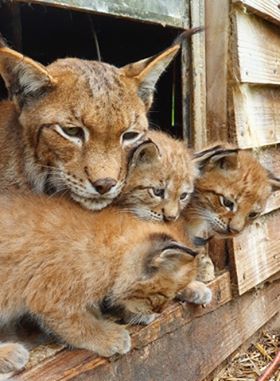
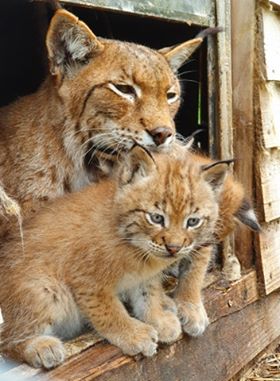
By the 6th June, the baby lynx opened their eyes. They are now delightful. By the end of the month they were patrolling their outside enclosure. They started on the 21st and all four are now kept in a crèche by both sisters, Fred and Orla. We already have a suitable home for one and another friend of mine who is a major consultant on British wildlife is hoping to obtain a licence for lynx. Among others, I enclose some photos from Sarah and Adam who took on two of our lynx two years ago. Although mainly, we exist for conservation, there is no doubt that animals in the right place with the correct licences in place do give a huge boost to mental fitness and sheer joy. Sarah and Adam have spent thousands of pounds on superb homes and enclosures for these animals, and even gave them a Christmas party. There is no doubt these animals are brilliantly catered for in every way and are very happy. I wish Sarah and Adam, Maia and Juno a very happy, comfortable, and relaxed life.
The young pumas from last year are still with us. Covid 19 put an end to a planned move abroad. We are now happy that they are going to a really nice home in Cambridgeshire, where the owners are building a house 75 feet by 30 feet. They have already had two huge lorries of rocks delivered as landscaping. We are now trying to train them for the move in August or September.
Rain in the early part of the month made the ground soft. It was almost solid after nearly eight weeks and the moles are now able to dig their burrows and throw up ‘earth hills’.
Several times almost daily, we have watched a mature fox in the field opposite our secret garden. She seems to live in a copse between two fields – and is out in daylight, probably hunting for an unseen earth of cubs.
A grey squirrel, a huge boy, is eating the birds fat ball feeder and has learned again to climb across the slim rope from which the bird feeders hang, a line which runs from our house to a fir tree some 30 feet away, which is on a pulley system that enables the contents to be refilled.
On 8th June we had had 16 fat balls consumed by birds and the ‘fat squirrel’, jackdaws and magpies took their share but the fledgling sparrows tits and finches all had enough. Even the robin and blackbird enjoy these fat balls.
On the 10th June, we enjoyed a ‘distance aware’ visit from Holly, the mammal keeper at Wildwood and her solicitor boyfriend, who shared the driving. They brought ‘Aero’ the male pine marten who has not bonded with their female and took our very well mannered ‘Terry’, who we all hope will make a marvellous husband to their female pine marten. It was necessary to do this as soon as the lockdown was eased as pine martens pair and breed in June/July and then the female keeps the eggs in “suspended animation” until the spring. Hopefully, we will know more next April or May.
As an aside, these animals are extraordinarily wily and clever. We actually caught Terry early in the live trap. Within an hour he had found a way out. From then on he had learned how the trap worked and jumped over the foot plate releasing the door and ate the bait. We caught him five more times in a net and four times he escaped. Little rascal!! He suffered no ill effects and apparently, Wildwood’s ‘young lady’ and he are flirting. High hopes!
We are now in a breeding relationship on pine martens and of course the Scottish wildcat, as well as a loose but very rewarding relationship with the local otter sanctuary with regard to Eurasian otters and short clawed Malaysian otters.
We currently have a young male Eurasian otter who will soon move on.
On 11th June, Cherry and I visited a small, local plant nursery for some plants for out hanging baskets. On our return journey just three miles from home, we saw a beautiful male yellow hammer. This stunning bird as bright a yellow as the flashiest canary, was my grandfather’s favourite bird. When I was just five or six years old, he took me bird watching and always stopped of the yellow hammer was singing his song, ‘a little bit of bread and no cheese,’ repeated several times.
In the field we overlook from our bedroom window and our secret garden, where my favourite tropical green house is situated, we have watched a fox. We first watched her on the 7th but over the next few days we saw her time and time again in daylight. We have a pair of captured foxes, not capable of release. There is nothing more “Mr Chipps” likes than having his chin rubbed or strokes around his ears. His mate ‘Roxy’ is slightly more reticent.
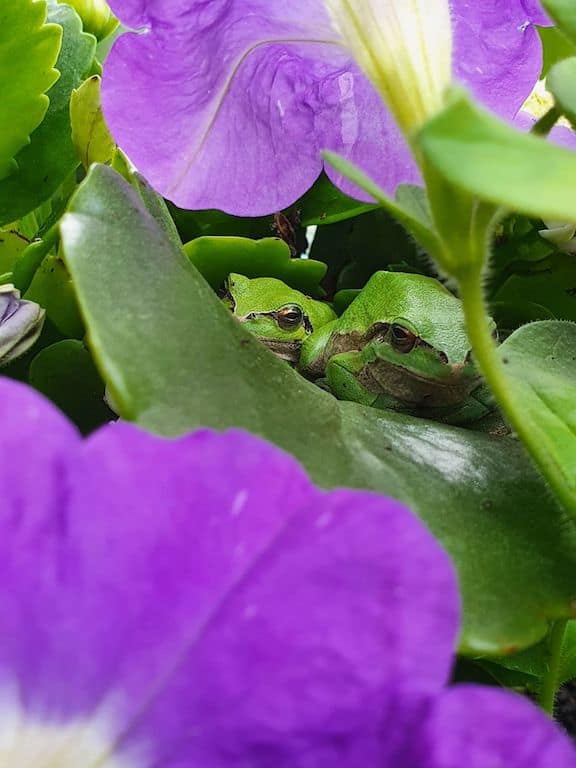
On the 19th June, I was gardening in long grass after a downpour when hundreds of froglets took it as a sign to hop on land and start the second phase of their life.
On the 22nd, I looked out of the bedroom window to see all of our bird feeders empty after only four days. I refilled all nine of them with peanuts, fat balls, niger and small seed, sunflower hearts, and within ten seconds house sparrows and blue tits were feeding followed by siskin, robin, great tit, female blackbird, nuthatch, jackdaw, siskin, and coal tit, all within minutes.
There is a young magpie family patrolling the garden. They particularly like feeding on the bird tables and hangers but more than anything cleaning up our car park where we feed the peacocks. They love grain, bread and almost everything else. We have seen no antagonism towards young, smaller birds. But, as I often think, it is our fault if we have unbalanced nature, not the magpies. Our young rescue magpie is very tame now and sits on anybody’s shoulder, hand or head if they feed him.
I have just taken the dogs, Tilley and Amber for their afternoon walk and heard a chiffchaff repeating his name, still a blackcap singing his sweet song, wood pigeons crooning, and have seen a couple of wrens chitting at each other excitedly, tails held over bodies, making a noise quite out of proportion to their size.
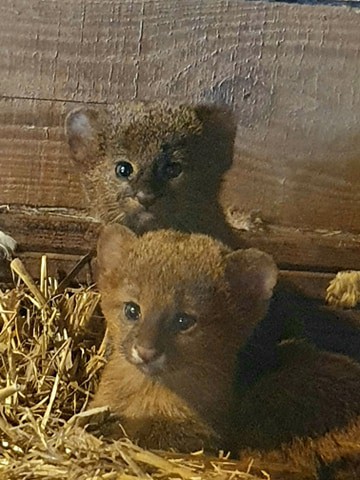
Our baby jaguarundi’s are growing all the time and are now starting to leave the nest box, one often staying with his father.
Finally we have seen no long tailed tits this month but on 27th we saw our first young woodpecker. The Rothschild’s Mynahs are setting in. We still have high hopes. The pair of marmoset boys are happy and particularly enjoy banana flavoured baby porridge.
We have added some insects to our lists but have not seen any new butterfly species since the small copper.
We wish all our members and readers safekeeping and hope this virus comes to an end quickly.
I hope all who might read this are keeping safe and like Cherry and me, find enormous restorative value in wildlife of all types.
Gallery of images this June

Sightings in June 2020
Below are our sightings up dated for the first half of the year.