
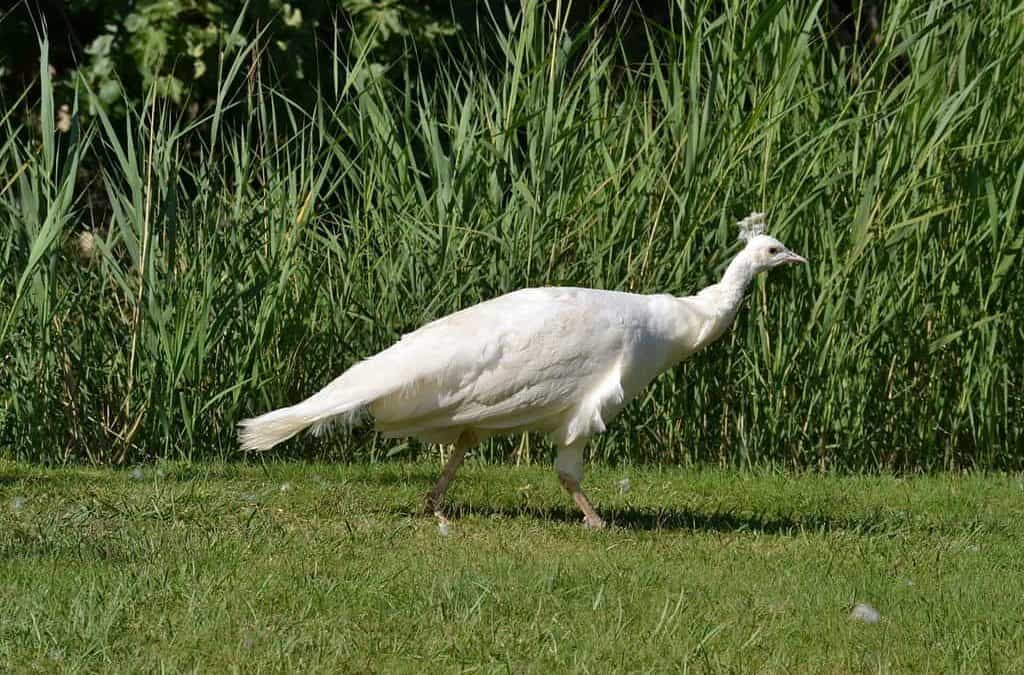
Late on a fine Monday afternoon, I was still in the office, when I received a phone call to ask if I would take on a Peahen. The call was from a client who lives further west in Cornwall about 40 minutes from us. Cherry suggested I went straight away as she had an early supper planned for that evening.
I arrived at a beautiful old manor surrounded by a low brook on which moorhen chicks were being fed by their mother and gunnera, some 7 feet tall was abounding. Being in a ‘frost pocket’, our gunnera dies off in the winter but here, it stood majestic and looked very tropical. Apparently, my client and his wife had caught what turned out to be a very attractive pure white peahen. They had young children and felt that the rather large soft droppings left by the bird were not making the most hygienic of play areas for their children. The Peahen had already been tempted into a garden shed where it was rather proving that unsanitary point. Gerald Durrell, I feel, would with his mastery of words, suggest that the garden shed was waist deep in Peacock guano. It was not quite that bad but certainly the sooner it was removed the better.
I quickly caught the bird and for its own safety, wrapped it by putting a “carrot net” over the bird with its head neatly popping out of a conveniently cut hole and then pulling the bag over its wings and body and then fully over its tail. Using some strong sticky tape the end of the net was sealed so that the bird could sit comfortably with its head free, but unable to move around in the car for the journey back to Tredivett Mill.
She sat absolutely still, looking this way and that as though she had been trained to sit in a carrot net from a few days old. She was a lovely calm example of a family having sometimes exposure reactions, always magnificent members of the pheasant family.
On my return, so that she could “home” to the area I placed her in a large aviary currently home to a pair of Golden Pheasant, very rare in the wild in China, but fortunately so beautiful is its plumage that it is a domestic favourite and kept in large numbers.
I checked on the water and food supply and went in for supper. Later that evening, when the dogs were having a pre-bed constitutional, I checked on the Peahen and the Pheasants to ensure that they were all calm. They were. Cherry and I went to bed having added another rescue to our ever increasing family.
The following morning, once I had prepared what we refer to as the “zoo food” for our collection, I went into my office as I had an early appointment. Cherry was driving out of our lane early to pick up some fresh fish for the Otters. I heard the Landrover being reversed fast down the lane and Cherry called out “You’ve got to come. She’s covered in blood.”
“Who?” I shouted, at the same time as running up the lane.
“The new Peahen” Cherry gasped as she caught up with me.
I could not believe my eyes. What had been a pure white Peahen yesterday, with beautiful head feathers forming a heavenly crown, was now a blood spattered bird that could not get off of its feet, sitting with its head covered in blood and one eye well and truly closed. It was awful to see. I looked around – perhaps the cock pheasant had attacked? No. Had a fox entered the aviary? If he had then where was the torn wire of the enclosure or any other tell tale sign? There were none. I went straight into the aviary and picked up the Peahen, cradling her in my arms. She did not resist. As I was straightening up some slight movement above me attracted my attention. That was it – a grey Squirrel had somehow managed to enter the aviary to eat some of the mixed corn feed but presumably had panicked when unable to exit the aviary. I could only assume that this may have happened in the night and this in turn panicked the Peahen. Both of the Pheasants were unhurt. We will never really know what happened, but certainly, the squirrel was still there so he was ‘prima facie’ guilty. As I felt that he may not able to afford a solicitor to defend himself, I gave him his freedom!
Cherry and I took the Peahen back to a quiet shed. While I held her, Cherry sprayed the whole of the birds head with a green antiseptic and then gave it a further spray with an anti-biotic which was blue. We then left her to rest, giving her some corn and peanuts (her favourite) and water. Although she had her head held high, one eye was closed and her legs were strained so that she was unable to stand supporting her body. Having checked it was clear that no bones were broken, she was still in shock, and we hoped that the eye would open naturally, so we intended to wait until the following day before handling and treating her in any further other way.
The following morning she looked pert and bright but had not attempted to move. Her eye was still closed. It seemed to be stuck closed by congealed blood. I picked her up and held her tight to my body to restrain any movement and her head in my other hand. Cherry then proceeded to swab the eye with warm salted water – a saline solution of ordinary table salt. She managed to wipe away the encrusted blood and once it was clean she put ordinary chloramphenicol eye drops into the affected eye.
There was no immediate result, but the same treatment was carried out three times each day. On the third morning both eyes were wide open but the bird still did not want to move. We let her rest.
On the fifth day she was standing up when we made our early morning rounds. She was eating and the guano stakes were rising. We opened the door and let her walk out. After such little movement we did not think she would go far. In fact, she walked several hundred yards and was in our furthest field ((noticed and pointed out by a local). Cherry and I decided she had had enough trauma so we did not try to catch her to bring her nearer the house. After all, she had been living wild and although her legs had been strained, her wings were not damaged. We thought she would be able to fly to roost, well off of the ground.
Two days later, she was walking around the yard when we rose in the morning. Her legs were recovered, her eyes were both bright but the unfortunate bird still looked rather clownish; pure white with a green and blue head. Fortunately we had a couple of nights rain so the blood had been washed away but it could not remove stains of the medicine sprays.
She became a permanent member with our peacocks, having a free life but subsidised with additional feed.

- A collection of short stories -
Tony is a passionate writer as well as an active conservationist. He is currently working on a number of books and we are delighted to be able to share a few stories from them.